

I think I experienced transference through my tv
Life was so much better when I was still watching Couples Therapy.

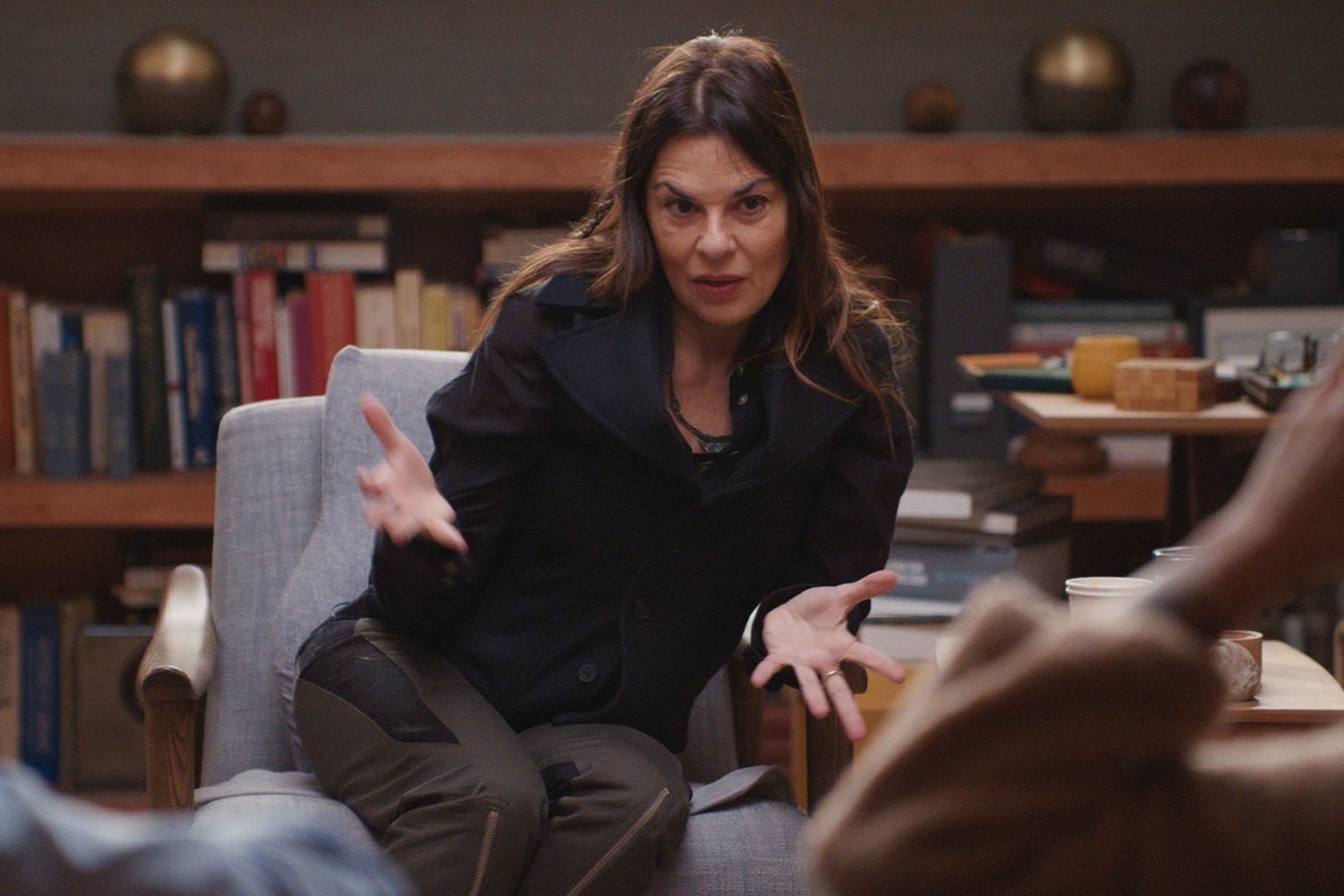
The other night I was lying in bed next to my husband, ostensibly reading a book before falling asleep, but instead I was privately raging about a freelance gig I regretted taking on. I turned off my lamp without saying goodnight, my back turned — not exactly a loving gesture. I wondered to myself what Dr. Orna would say about my need to isolate whenever I had bad feelings. Then I had the thought, as genuine as I think anything: God, life was so much better when we were watching Couples Therapy.
Have you seen this show yet? If you have, let’s talk about everyone. If you haven’t but you keep seeing this woman’s active listening face pop up on TikTok or hear her name referenced on podcasts and are wondering what the fuck this is? Please, let me relive my viewing experience a little bit by trying to capture why it’s so good.
Because short of waiting for a new season (too long) or actually enrolling in real-life couples therapy (expensive; seems hard; wouldn’t include Dr. Orna), I’m not sure how else to get that feeling back. “That feeling” being that life has meaning because I have more episodes of Couples Therapy to watch, preferably on my laptop in bed, next to my husband who is half-watching and half reading or looking at his phone, but lets me slap his arm and pause the show every once in awhile to recap what just happened or correctly predict someone’s trauma history. (This is against the spirit of the show, and also the spirit of being a good and normal person, but like — ? I rest my case.)
Ok, so, this show has been airing since 2019 but this year it has really broken through, for me personally, and it’s everywhere. Maybe it’s my algorithm, maybe it’s a genuine pop-cultural phenomenon, I see Couples Therapy clips everywhere. And I have to say that while Orna’s mesmerizing therapeutic skills are still all there, on display in short-form video, true Orna-heads know you GOTTA watch the whole story. You have to see these people in full context. Context is what the whole thing is about!
And you have to see as much as you can of Dr. Orna in action. For starters, this is her, not therapizing:
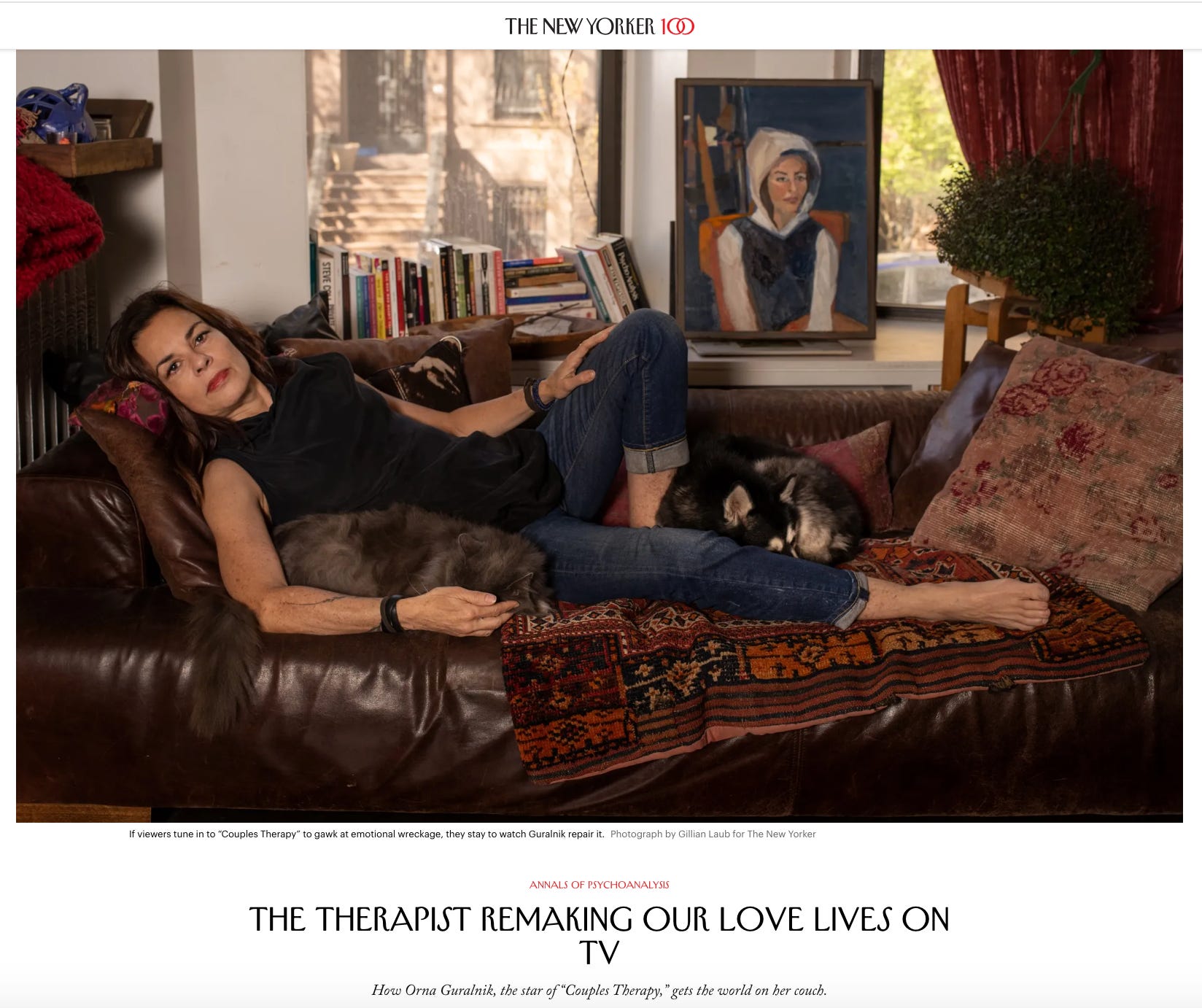
It must be said that Dr. Orna is really pretty hot in a normal human woman way, if an incredibly skilled psychoanalyst be considered normal. But what really makes her attractive, an object of obsession really, comes from the experience of watching her be good at her job.
Though I should back up. Couples Therapy the show is what it sounds like, and what it looks like on Reels: literal, real couples therapy sessions, where couples agree to be filmed, ostensibly in exchange for free therapy, but probably also for murkier personal reasons. However compelling you’re imagining this show to be, it’s more so. It can be uneasy viewing if your preferred genre isn’t People Yell & Cry, but — LIKE THERAPY ITSELF – if you can tolerate the discomfort, revelation will follow.
The episodes bop around deftly between couples, with themes threaded and narratives expertly paced to unfold in a way that is satisfying. Eagle-eyed viewers / Orna obsessives will note the outfits and the way they’re sometimes shown out of order, but in fact we appreciate this, even as it calls to the artifice, if you could call it that. And whether there is artifice is one of the more fun questions to ask yourself slash argue with your husband about between episodes. The show bills itself as a “documentary,” and “IT’S A DOCUMENTARY!” is exactly what I found myself shouting at Dustin more than once after he was so bold as to refer to it as “reality tv.”
“It’s not fucking Housewives?!” I countered, meaning it’s not like there’s a person whispering in an earpiece to ask about someone’s mom, or encouraging the couples before their session to get into their hangups around sex. You could argue there is something about the observer effect that inevitably shapes the situation, and makes people perform a bit (also OKAY, it is filmed on a set that’s made to look like her office), but, as I argued, don’t all couples go in ready to perform a bit? To win their case?
However, yes, they obviously “find it in the edit.” If they didn’t, the show would be borderline unwatchable. Instead what we end up with is a fantasy version of what therapy is, or could be. Mid-binge watch, we went on a family camping trip off the grid so, to tide me over, I took my copy of Janet Malcolm’s Psychoanalysis: The Impossible Profession to finally actually read. The book starts out with some dense Freud theoretical history you can let wash over you before you get to some fun 1980s in New York psychoanalyst office politics stuff (transcendent!), but eventually she mentions Ernst Kris’s 1956 concept of the “good analytic hour”:
“This hour,” Malcolm writes, “comes only rarely, if at all, in the course of an analysis, then she quotes the paper, how the good hour “seems as if prepared in advance…All seems to click, and material comes flowing…as if prepared outside of awareness.”
Isn’t this the promise of Couples Therapy? Isn’t it, via editing, literally prepared in advance? (“But it’s a documentary!”)
This therapy-narrative interplay makes thinking about and watching this show so fun. The expectations and fantasies that an audience brings to the show (and narrative in general) are an echo of the fantasies that a patient brings to therapy. Especially couples therapy. For the show’s participants, who know they’re being filmed, it’s even more extreme.
You have to imagine, speaking of Malcolm, all the Journalist and the Murderer type motivational shit: The desire to be heard, wanting to be right, not really understanding what you were signing up for, the fantasy of winning over the public. The belief that if you can only get the story right, something will be unlocked.
The magic of this show is that their and our desire for story is indulged, partly, in the edit. In this version of therapy there are no detours, no dead ends; if there is resistance or avoidance, or even missteps, they are only present to the degree that they generate verisimilitude, and more importantly, suspense.
What we actually end up getting to see is of course the fantasy version of what therapy is, especially psychoanalysis. As viewers, we get to engage in the pursuit of insight without having to “do the work.” We barely have to suspend disbelief. It’s, in most cases, an actual trauma plot. Catharsis pretty much guaranteed. (Except for Mau and Boris, IYKYK, and maybe that’s what’s so maddening about narcissists, they deny us the possibility of a real breakthrough.)
The version of catharsis is, for me, the most transcendent kind, and it’s what drives the show. It’s also what drives so much of contemporary fiction (and then tv, lol), the puzzle pieces falling into place, everything making sense in retrospect. Because the question is never really, “Who is right? or even, “Will this couple stay together?” (ultimately black and white and pretty boring, though fun to look up on Reddit), but instead: How did these particular people get to this particular place?
The best part is, Dr. Orna always makes sure we find out. Because this isn’t some cognitive behavioral therapy shit or EMDR or whatever other modality that might be more efficient, or even more effective for some of these poor couples that walk into Dr. Orna’s office. But doing DBT worksheets would make for way worse television. This is psychoanalysis, assholes, so if there is self-betterment, it will be the kind that we like to assume comes with self-knowledge.
Watch enough of this show in quick succession and you, 1.), start to realize there are only about five issues people have and they are all related to their parents, and 2.) truly begin to wonder how anyone, ever, maintains an intimate committed relationship.
Orna, for her part, seems to believe. It’s not her job to keep the couple together, but as she thrillingly convinces to her supervisor, some part of her is always rooting for them. With Orna’s steady presence, you kind of can’t help but internalize how challenging but beautiful a true connected relationship is; how against the odds and hard-won. After a few weeks of viewing, Dustin and I were more careful with each other, I think. We said more, checked in more, pressed each other for honesty. “What are you really asking me for?” “When you said x, did you really mean Y?”
It’s not so much that these couples in crisis put the fear in God in me, but they make it so glaringly obvious, over and over, that we are all so oblivious to the ways the past is at work in us. It’s almost funny, how much we need each other and how stupidly we go about it.

You imagine, or I fantasize, that Orna knows immediately what is going on with all these couples, but she waits for them to get there in their own time.
The Malcolm book also references Winnicott’s Playing and Reality, so I pulled that off of my mom book shelf1, where Winnicott talks a lot about not busting out immediately with your analyst interpretation. The joy of this, he says quite poignantly, is dwarfed by watching the patient come to it on their own. “The patient arrives at understanding creatively and with immense joy, and I now enjoy this joy more than I used to enjoy the sense of having been clever.”
Where does the joy of the viewer fit in here? It it Orna who would theoretically experience the double pleasure, watching us pursue the insight along with the patient, or do we get to experience the pleasure of Orna experiencing the pleasure of the patient? AND/OR, by withholding information and shaping the hour of the session itself, is the Couples Therapy editor the one who is either the good object or a bad version of the good object, over-interpreting for the viewer, and robbing us ultimately of arriving at the participant’s insight right along with them?
In Malcolm’s book, she moves from this Winnicott idea of interpretive restraint right into Proust (! re: narrative) and then back to transference: “At the heart of the ordeal,” as Malcolm puts it, “is the transference neurosis, described by Freud as an artificial illness that the analysis itself brings into being. It takes the form of the patient’s obsessive interest in the person of the analyst.” On some level, is this not what we are experiencing?
Is Paramount+ our makeshift version of the safe container of the 50-minute session? Is Couples Therapy, the show, in its peculiar way of bridging fact and fantasy, a transitional object?
I’m kidding, KIND OF, but also, there’s something there.2
On what was, unbeknownst to me, the night we would finish our fugue state inhaling of the four seasons of the series, I texted Dustin from upstairs and told him it was time for our session. “Lollll,” he wrote back, but still, he came up and got into bed and we watched our nightly game show together, him indulging my commentary, even adding in a “oh my god” whenever I said something five seconds before Orna did. Now it’s over, and we need to find some other cultural phenomenon to experience as a way to address our own interpersonal issues. If anyone knows any tv shows where a thwarted writer overcomes her disorganized attachment style to be a better wife and mother pls lmk.
Did I mention I was unemployed?
IBID
Meaghan, I just watched some episodes of this on the final 3 hours of an 11 hour flight home in a weird sleepless delirious state--and am now commenting on your piece in a weird delirious jet lag state. It felt like to me that the dr. mostly just asks the clients questions with those intense eyebrows. The episodes I had access to had the poly guy w/ the two girlfriends, one of whom was in the circus and I almost died listening to them. I looooved Dr. Orna's reading of the dude--a total dressing down.
I like the show best when she talked about her work with her peers and with her supervisor. Do you pay for Esther Perel's content on Apple podcasts? If not, I suggest you do for her Clinical Sessions with other therapists. I loooove hearing how they go about their therapizing...
Also completely obsessed with this show. I would happily watch 100 hours of it! Give us more!